


The Great Fire of 1876 and Concrete Vision
Blenheim's early public administration operated from wooden buildings that were highly vulnerable to fire.1 Shortly after 1:00 a.m. on 2 November 1876, a blaze broke out in the western wing of the original timber Government Buildings block.6 Fanned by a strong westerly wind, the conflagration consumed the complex housing the Post Office, Telegraph Office, Courthouse, Supreme Court, Resident Magistrate's offices, Customs, Survey, Provincial Government, and Land Transfer.6 Flames swept across Market Place and destroyed approximately twenty-four buildings, resulting in total record losses for local courts, the post office, and the Borough Council.6 While brick safes saved Land Transfer deeds and original survey maps, emergency telegraph services had to operate from a tent on Seymour Square.6
Determined to prevent future disasters, community leaders advocated for a permanent replacement built from fire-resistant materials.1,2 Colonial Architect William Henry Clayton designed a grand civic facility constructed entirely of mass concrete, representing an early use of the material for government architecture in New Zealand.2,4 Contractor John Knight began construction in June 1877, and the building reached formal completion in July 1878 at a cost of 11,000 pounds.1,2 Positioned in the centre of town within Market Square, the complex comprised post and telegraph facilities alongside land, survey, and judicial offices.2,7
Architectural Craft and William Ah Gee
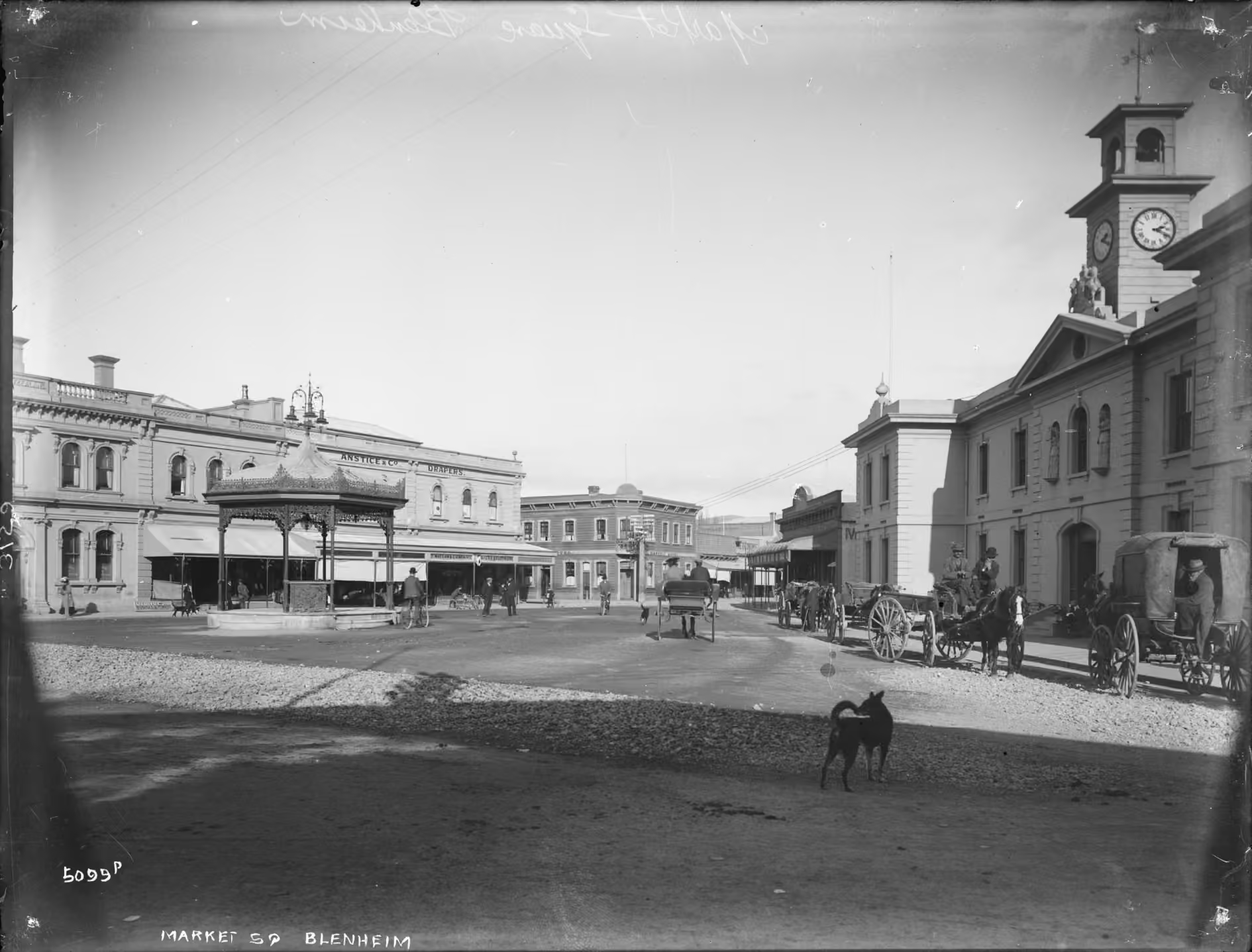
The new complex accommodated several government branches, with the Post Office occupying the lower right section with its own public entrance.2 The upper facade was embellished with concrete state emblems featuring the Lion and the Unicorn over the main door and side elevations.1,2 Set within wall niches beneath the central clock tower were two four-foot stucco female figures representing Justice and Truth, though residents popularly referred to them as Justice and Mercy.1,2
Artisan William Ah Gee directed the creation of these concrete embellishments, working out of a temporary shed behind the construction site.1 Born in Guangdong province, China, Ah Gee had trained in Melbourne at the Kem Wah workshop, winning a medal at the 1866 Intercolonial Exhibition before arriving in Wellington in 1868.5 After marrying Jane Melbourne in 1871, he established himself in Blenheim as a skilled carver and gilder by the late 1870s.5 Working in pieces, Ah Gee cast the trusses, state coats of arms, and the two niche figures, carving the concrete book held by the figure of Mercy.1,3
Expansion, Floods, and Postcard Evolution
Situated in low-lying Market Square, the building frequently faced severe floodwaters from the nearby river network.2 Heavy rain inundated the site during the 1890s, while a July 1911 flood forced the Post Office to close as water rose six inches inside the ground floor.2 In May 1923, heavy downpours sent two feet of floodwater through the departmental quarters.2
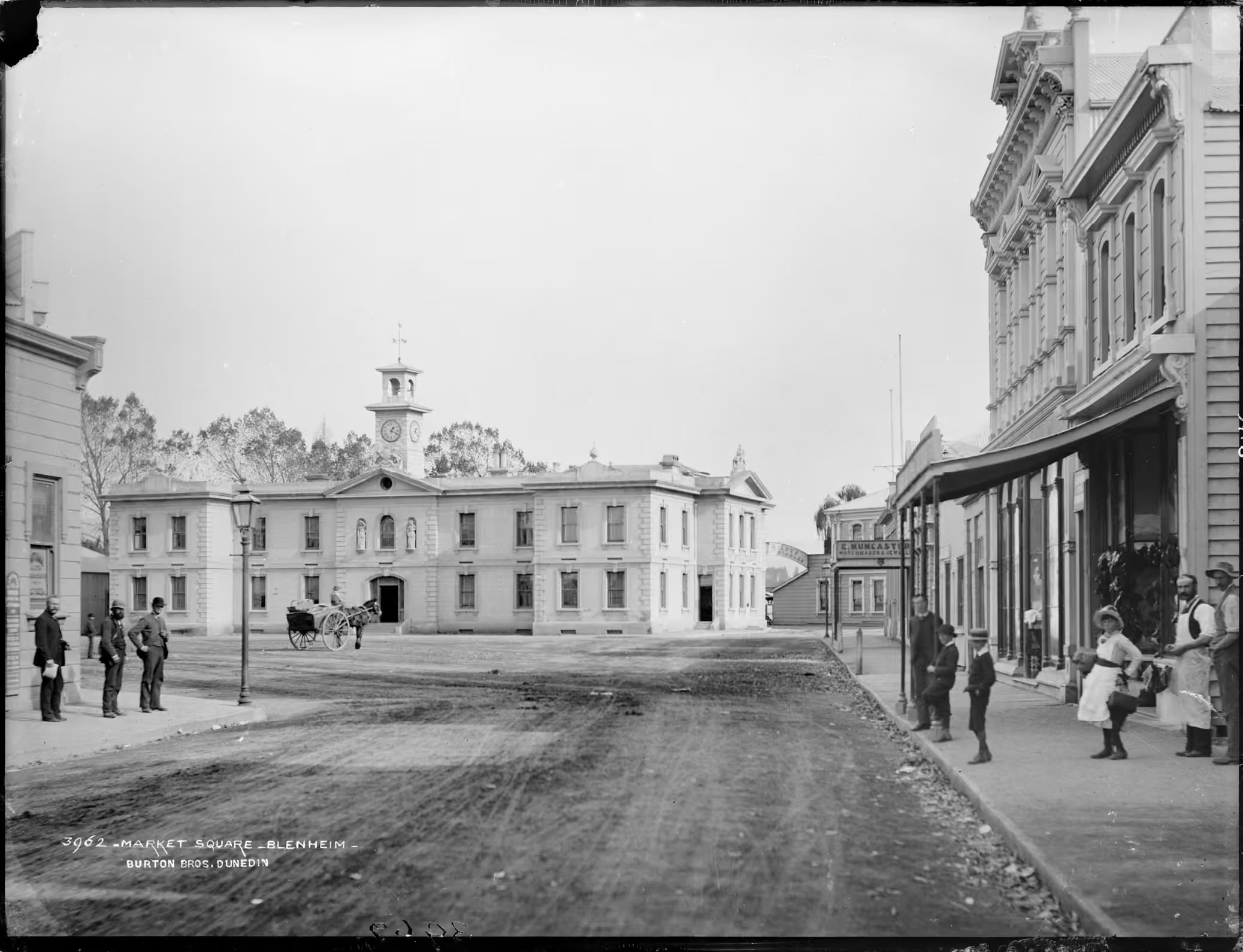
Growing administrative demands prompted structural modifications over time.2 In 1912, work began on a two-storey extension along Queen Street to expand the telephone exchange and establish a dedicated public entrance and posting lobby.2 Photographic records and historic postcards trace these ongoing changes across the early twentieth century.2 By the 1920s, the original right-hand doorway was closed, a telephone box was installed outside, and the building received a uniform coat of light paint.2
Structural Changes, The 1968 Heist, and Demolition
During the mid-twentieth century, safety concerns led to major alterations to the building's upper exterior.1,2 Following regional earthquakes in 1929 and 1931, the upper top of the clock tower was removed, the state coats of arms were taken down, and the wall niches were filled.1,2 While earlier accounts suggested the statues were removed during the 1940s, historical records also indicate they were taken down in late 1953 when the building was repainted in pastel tones prior to the visit of Queen Elizabeth II in January 1954.1 Custodian Bert Knight witnessed the removal, noting the statues were broken up and disposed of at the local dump, though he salvaged the concrete book sculpted by Ah Gee.1 His son Rodney Knight donated the surviving artefact to Goodwin & Associates in 1999.1,3
In 1968, the building became the site of New Zealand's largest burglary at the time when thieves used explosives to blow open the safe door and steal 51,000 dollars.2 Police arrested two local men two days later and recovered most of the stolen money.2 The 1878 concrete structure was demolished in the early 1970s and replaced by a modern post office facility in 1974.1,2 Today, a replica clock tower near the original Market Square site commemorates the former civic landmark.2