Ngā Kaimoana: A Traditional Larder
Long before commercial marine farms appeared in the 1960s, the Marlborough Sounds served as a vital food basket for Māori.1 For more than 1,000 years, tangata whenua harvested kaimoana from local reefs, gathering staples such as kūtai (green mussels), kuku (blue mussels), tuangi (cockles), pāua, tipa (scallops), and seaweed.2 Oral history records that local iwi practised early resource management, transplanting shellfish and seaweed closer to their kāinga to ensure reliable food gathering during adverse weather.3
Locations including Waitohi / Picton Harbour, Waikawa Bay, Shakespeare Bay, and Karaka Point were revered as Pātaka Kai (food cupboards).4 Harvesting in these areas was governed by kaitiaki (guardians), requiring permission from local whānau or hapū to maintain sustainability.5 Under the Māori Aquaculture Claims Settlement Act, Te Tau Ihu iwi remain primary stakeholders and leaders across the modern marine farming sector.6
Crisis and Legislation: The Birth of an Industry
The modern aquaculture industry emerged from ecological necessity in the 1960s.7,8 Decades of commercial dredging and hand-harvesting severely depleted wild mussel beds, reducing populations to unsustainable levels.9 In response, the New Zealand Government established the Fisheries Research Division to investigate marine farming options as a viable alternative to wild extraction.10
Parliament passed the Marine Farming Act 1968, creating a legal framework for marine cultivation.11 Enticed by the research, early entrepreneurs recognised the potential of the Marlborough Sounds, where deep, nutrient-rich waters and sheltered bays provided ideal conditions for shellfish cultivation.12,13
Among these pioneers were Keith Yealands and his sons Stephen, Kevin, and Peter, who anchored experimental mussel rafts in Kenepuru Sound.14 Following the formal licensing of the industry, the Yealands family secured Marine Licence No. 1 at Ruakaka Bay in Queen Charlotte Sound / Tōtaranui in 1975, marking the official beginning of commercial marine farming in New Zealand.15
Trial, Error, and Early Innovation
Initial cultivation trials were defined by physical hardship and technical failures.16,17 The earliest government and industry test rafts consisted of heavy concrete structures that rapidly broke apart and sank.18 In response, the Yealands family constructed lighter pontoons from polystyrene, plywood, and fibreglass in Grovetown, sitting high above the water to accommodate line weight as mussels matured.19
Farmers faced constant setbacks, including unreliable spat supplies, equipment loss during strong tides, and heavy predation from fish species such as snapper and spotties.20 Early harvesters experimented with spotty traps, altered culture line loops, and even gelignite to protect young stock.21 The first commercial harvest occurred on 11 September 1971 from Associated Fishermen Nelson rafts in Kenepuru Sound, yielding 150 cases of mussels.22
Manual labour dominated the early era.23 Workers stripped mussels from lines using rubber boots in a technique known as the Kenepuru stomp, while modified wringer washing machines were adapted to declump harvested shellfish.24 Spat was painstakingly bound to ropes by hand using Spanish lace, requiring up to 80 hours of labour per week from farming families.25
The Longline Revolution and Mechanisation
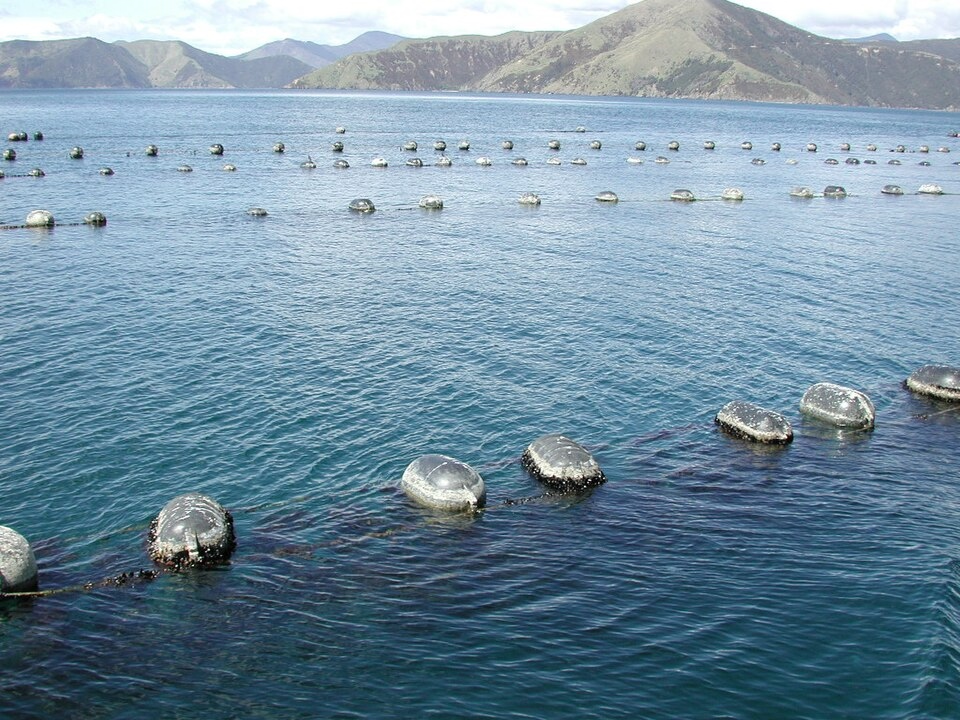
In 1975, Fishing Industry Board officer Jim Jenkins introduced the continuous longline system to Marlborough after observing oyster and scallop farming practices in Japan.26 Marlborough fishermen crossed Cook Strait to Plimmerton to collect plastic floats discarded by Japanese fishing vessels, securing them to backbone ropes anchored in deeper water.27 This transition replaced rigid rafts with flexible lines capable of enduring rough sea conditions.28
Mechanisation rapidly transformed on-water operations.29 Kevin Yealands built hydraulic winches to replace grueling hand winches, while Don and Liz Mitchell launched the first towed harvesting barge, Brutus, in 1980.30 In 1987, Chris and Sue Godsiff, alongside Rob Pooley, commissioned the Pelorus Trader, the region's first motorised harvesting barge equipped with crew quarters for continuous shift work.31
Institutional structures evolved alongside technology.32,33 The Marlborough Sounds Marine Farming Association was established in 1974, changing its name to the New Zealand Marine Farming Association in 1986 and later adopting Marine Farming Association in 2007.34
From Green-Lipped to Greenshell™
Rapid industry expansion in the early 1980s triggered a severe market glut.35 Between 1981 and 1982, Wellington retail prices plummeted from $27 to $5 per sack.36 In response, the Mussel Promotion Council was established in 1981, launching radio and supermarket promotions, while local contractor Michael Hitchins engineered live mussel display cabinets for retail stores.37
By 1990, the New Zealand industry trademarked the name Greenshell™, establishing global brand recognition.38 To satisfy strict export market standards, particularly in the United States, the industry established the Shellfish Sanitation Programme in 1983.39 Operating today as the Marlborough Shellfish Quality Programme alongside the Cawthron Institute, it conducts weekly water and tissue testing for phytoplankton and bacterial levels.40
The Salmon Pioneer
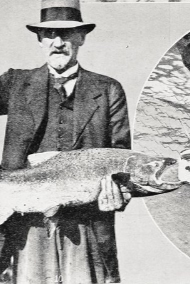
The establishment of New Zealand's salmon fishery was directed by Lake Falconer Ayson, Chief Inspector of Fisheries from 1899 to 1926.41 After observing overseas fisheries management in 1898, Ayson identified that earlier attempts to introduce Atlantic salmon failed to establish sea-run populations because small consignments were distributed across too many rivers.42
Ayson adopted a concentration strategy, focusing releases into a single river system.43 Between 1900 and 1906, he oversaw five importations of Quinnat (King) salmon ova from the Baird Hatchery in California, rearing them at a dedicated hatchery on the Hakataramea River, a tributary of the Waitaki River.44 The species established self-sustaining runs and spread northwards along the South Island coast, founding the wild stock used for subsequent commercial farming.45,46
King Salmon Commercialisation
Commercial King salmon farming began in New Zealand in 1976 with an ocean ranching operation at Te Waikoropupu Springs in Tasman, followed by the nation's first sea pen farm at Stewart Island in 1983.47 In the Marlborough Sounds, Gavin Corbett and Earl Smith conducted initial trials at Mills Bay, though shallow, warm water proved unsuitable.48 Pioneer Jim Jenkins established an early farm at Elie Bay in 1984, while Mark Gillard launched a pilot programme at Hallam Cove in 1985.49,50
Regal Salmon Ltd, established by Jim Jenkins, Andrew King, and Terry Shagin, developed a hatchery at Spring Creek and established net pen farms at Elie Bay and Ruakaka.51 In 1996, Regal Salmon merged with Southern Ocean Seafoods to form The New Zealand King Salmon Company.52 Net pen operations expanded across Marlborough, including sites at Otanerau (1989), Waihinau Bay (1989), Te Pangu (1990), Forsyth Bay (1994), Clay Point (2006), Crail Bay (2009/2010), Ngāmāhau (2015), Waitata (2016), and Kopāua (2016).53
Company hatcheries were rationalised to improve efficiency, with Tentburn dedicated to smolt production and Te Waikoropupu Springs focused on broodstock and eggs.54,55 Modern feed formulations transitioned from wild fishery feeds to pressure-cooked pellets incorporating food industry by-products, reducing environmental benthic discharge.56
Regional Impact and Regulatory Framework
Today, Marlborough contains 590 marine farms covering 3,200 hectares of water space, generating over 1,000 direct jobs across farming, processing, and logistics.57 Annual production averages 60,000 to 65,000 tonnes of Greenshell™ mussels, 6,000 to 8,000 tonnes of King salmon, and 130 tonnes of oysters, earning over $280 million in export returns.58,59
Aquaculture reshaped coastal communities such as Waitaria Bay in Kenepuru Sound, where the local school roll grew from 12 to 51 pupils between 1974 and 1994.60 In 1987, children's author Joy Cowley funded the restoration of the 1897 Waitaria Bay schoolhouse to provide additional classroom space.61
Under the Resource Management Act and New Zealand Coastal Policy Statement, the Marlborough District Council regulates farm boundaries, lighting, structures, and seabed discharges.62 Compliance monitoring is supported by the Cawthron Institute using DNA barcoding technologies to assess seabed samples.63