The Collector with a Vision
By day he worked as a pharmacist, but his real passion lay in capturing the region's history. A keen tramper, he walked much of Marlborough's hinterland, observing its past firsthand. He was also a skilled photographer and film processor, carrying his Zeiss cameras across the district to document people, buildings, and events. From around 1960, he began an inspired project to copy and collect old Marlborough photographs, visiting families and organisations to preserve their visual heritage.
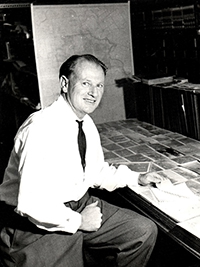
During the 1960s, Norm Brayshaw began gathering anything related to Marlborough's agricultural and social history. Norm could see the machines that our pioneers used were being lost to future generations.1 To formalise this preservation effort, he founded the Marlborough Vintage Farm Machinery Society in 1965.2
In the early days, he would tow machinery back from farmyards with his old car, or haul items using a homemade transporter he dragged behind him.3,4 These recovery efforts were often funded by a quiet whip round among fellow enthusiasts to cover transport costs.5
One of the oldest surviving assets in this collection is an 1855 horse-drawn Cuthbert Harvester.6 Initially imported to Nelson by H. Redwood, it was used on the Waimea Plain, shipped to his son's property in Blenheim, and later operated on a Pelorus Valley farm until 1891.7
From a Dump to a Destination
Norm's dream was to create a central place to house these growing collections. In 1965, he received initial permission to store old machinery on the site of the former Blenheim Borough Council rubbish dump.8 To the East of the dump was a site used for saw milling operations which was for a good period of the time occupied by Musgroves.9 Adjacent to that, near the Taylor River, lay the Borough Council's gravel screening, crushing plant, and stockpiling areas.10
The formal transition from a wasteland to a heritage hub began in November 1968 when the Marlborough Historical Society leased the unused land from the Marlborough Catchment Board.11 Parts of the original lease were quickly sub-leased in 1969 to the Marlborough Associated Modellers Society and the Vintage Car Club to build a collaborative community space.12
The park officially opened to the public on 25 September 1971.13 The ceremony was performed by Bill Chisholm, the manager of Molesworth Station, which had generously donated much of the early vintage machinery to the collection.14
In 1972, a further area was sub-leased directly to the Marlborough Historical Society.15 By 1976, the site had expanded to a 14-acre park boasting New Zealand's largest collection of vintage farm machinery.16 Under Brayshaw's direct supervision, voluntary efforts constructed replica streetscapes known as 'Beavertown', alongside a model boating pond, flying circle, and miniature railway layout.17,18
The site eventually grew to include over twenty sheds.19 This included the Denton Building, constructed from a large bequest by retired farmer Ralph Denton to specifically house restored tractors.20 Further expansion was funded by the community-driven 'Square Metre Club', which invited farmers and local businesses to donate $330 per square metre to fund new display buildings.21
An Enduring Legacy
Norm Brayshaw's influence extended far beyond the park boundaries. In 1964, he published Canvas and Gold: a history of the Wakamarina goldfields, an essential text documenting early regional mining efforts and capturing pioneer accounts that might have otherwise vanished.22 He also played a crucial role in establishing local museums in Renwick, Havelock, and Picton, ensuring these distinct communities retained control over their unique historical records.23 When others saw only a decaying hulk, he championed the recovery and preservation of the historic vessel Edwin Fox, securing its place in Marlborough's maritime narrative.24 To protect vulnerable documents, the Marlborough Archives were stored for many years inside a corrugated iron shed behind his personal residence.25
His organisational capabilities provided the administrative infrastructure required for long-term regional preservation, particularly during his tenure as secretary and treasurer of the Marlborough Historical Society from 1960 to 1972.26 This dedication to the society was shared by his wife, Beverley Brayshaw, who later served as its patron for many years.27
His extensive community contributions earned formal recognition on 1 January 1975, when he received the British Empire Medal (Civil Division).28 Norm passed away suddenly at his Blenheim home on 27 February 1981 in his 60th year, survived by Beverley and their children.29 Following a well-attended funeral service at St Andrew's Anglican Church, local enthusiasts and community members immediately stepped forward to continue expanding his life's work.30 Today, a commemorative mural at Brayshaw Heritage Park marks his foundational efforts across a site that now hosts twelve regional heritage organisations.31 In October 2023, his daughters visited the park, taking time to view the massive and lasting regional resource built from their father's early collecting excursions.32